Up
The Ottoman Harem (Imperial Harem)
The harem had its own internal organization and order of formulating policies. Beneath the Valide Sultan in the hierarchy was the Haseki Sultan, the mother of the sultan's first-born son, who had the best chance of becoming the next Valide Sultan. The sultan also had four other official wives, who were each called Haseki Kadın. Next in rank below the sultan's wives were his eight favourite concubines (ikbāls or hās odalıks), and then the other concubines whom the sultan favoured and who were termed gözde. Next in rank were the concubines of other court officials. Pupils (acemī) and novices (cāriye or şāhgird) were younger women who were either waiting to be married off to someone or who had not yet graduated out of the Harem School.
A Note
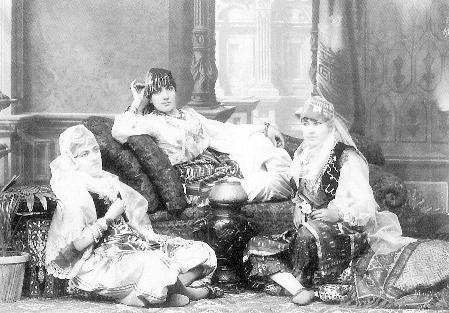
Nor should we disparage the endless pornographic fantasies that revolve around the Harīm of the Sult.ān's Topkapļ Palace. Fascination with this is now often disparaged as "Orientalism," i.e. the projection of unrelated and hostile imaginings onto misunderstood institutions; but there is no doubt of the extraordinary and bizarre characteristics of the Imperial Harīm. If it was diverting for the Sult.ān, I don't see why it should not continue to be so to the curious modern. An honest and informed treatment of this can be found in Harem, The World Behind the Veil [Abbeville Press, New York, London, Paris, 1989], by a woman who grew up in Turkey, Alev Lytle Croutier, many of whose own relatives had lived in traditional harīms. The books contains photographs from the Ottoman era (including her relatives) as well as historical drawings and the sort of lush and sensual paintings by Western artists that infuriate the anti-"Orientalism" crowd. The image above is a 19th century photograph. It is given by Croutier [p.74], but I also remember it from many years ago in Time magazine, at the time that the Topkapļ Harīm was first opened to the public....read more
TransAnatolie Tour
[ Home ] [ Up ]