Up
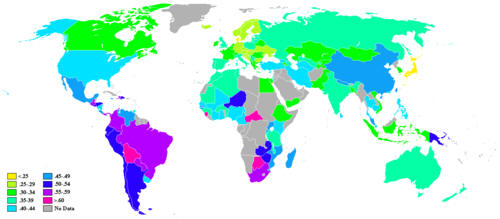
The Gini coefficient is a measure of statistical dispersion most prominently used as a measure of inequality of income distribution or inequality of wealth distribution. It is defined as a ratio with values between 0 and 1: the numerator is the area between the Lorenz curve of the distribution and the uniform distribution line; the denominator is the area under the uniform distribution line. Thus, a low Gini coefficient indicates more equal income or wealth distribution, while a high Gini coefficient indicates more unequal distribution. 0 corresponds to perfect equality (everyone having exactly the same income) and 1 corresponds to perfect inequality (where one person has all the income, while everyone else has zero income). The Gini coefficient requires that no one have a negative net income or wealth.
The Gini coefficient was developed by the Italian statistician Corrado Gini and published in his 1912 paper "Variabilità e mutabilità" ("Variability and Mutability"). The Gini coefficient is also commonly used for the measurement of the discriminatory power of rating systems in credit risk management. The Gini index is the Gini coefficient expressed as a percentage, and is equal to the Gini coefficient multiplied by 100. (The Gini coefficient is equal to half of the relative mean difference.)
[ Home ] [ Up ]