Urartu and Urartians
Urartu is a geographical
region commonly used as the exonym for the Iron Age kingdom also known
by the modern rendition of its endonym, the Kingdom of Van, centered
around Lake Van. The kingdom rose to power in the mid-9th century BC,
but went into gradual decline and was eventually conquered by the
Iranian Medes in the early 6th century BC.
Assyrian inscriptions of Shalmaneser I (c. 1274 BC) first mention
Uruartri as one of the states of Nairi, a loose confederation of small
kingdoms and tribal states in the thirteenth to eleventh centuries BC
which he conquered. Uruartri itself was in the region around Lake Van.
The Nairi states were repeatedly subjected to further attacks and
invasions by the Middle and Neo-Assyrian Empires, which lay to the south
in Upper Mesopotamia ("the Jazirah") and northern Syria, especially
under Tukulti-Ninurta I (c. 1240 BC), Tiglath-Pileser I (c. 1100 BC),
Ashur-bel-kala (c. 1070 BC), Adad-nirari II (c. 900 BC), Tukulti-Ninurta
II (c. 890 BC), and Ashurnasirpal II (883–859 BC).
Urartu reemerged in Assyrian language inscriptions in the ninth century
BC as a powerful northern rival to the Neo-Assyrian Empire. The Nairi
states and tribes became unified kingdom under King Arame of Urartu (c.
860–843 BC), whose capitals, first at Sugunia and then at Arzashkun,
were captured by the Assyrians under the Neo-Assyrian emperor
Shalmaneser III.
Urartologist Paul Zimansky speculated that the Urartians, or at least
their ruling family after Arame, may have emigrated northwest into the
Lake Van region from their religious capital of Musasir. According to
Zimansky, the Urartian ruling class were few in number and governed over
an ethnically, culturally, and linguistically diverse population.
Zimansky went so far as to suggest that the kings of Urartu might have
come from various ethnic backgrounds themselves.
Assyria fell into a period of temporary stagnation for decades during
the first half of the 8th century BC, which had aided Urartu's growth.
Within a short time it became one of the largest and most powerful
states in the Near East.
Urartu reached the highest point of its military might under Menua's son
Argishti I (c. 785–760 BC), becoming one of the most powerful kingdoms
of ancient Near East. Argishti I added more territories along the Aras
and Lake Sevan, and frustrated Shalmaneser IV's campaigns against him.
Argishti also founded several new cities, most notably Erebuni Fortress
in 782 BC. 6600 prisoners of war from Hatti and Supani were settled in
the new city.
At its height, the Urartu kingdom stretched north beyond the Aras and
Lake Sevan, encompassing present-day Armenia and even the southern part
of present-day Georgia almost to the shores of the Black Sea; west to
the sources of the Euphrates; east to present-day Tabriz, Lake Urmia,
and beyond; and south to the sources of the Tigris.
Tiglath-Pileser III of Assyria conquered Urartu in the first year of his
reign (745 BC). There the Assyrians found horsemen and horses, tamed as
colts for riding, that were unequalled in the south, where they were
harnessed to Assyrian war-chariots.
In 714 BC, the Urartian kingdom suffered heavily from Cimmerian raids
and the campaigns of Sargon II. The main temple at Musasir was sacked,
and the Urartian king Rusa I was crushingly defeated by Sargon II at
Lake Urmia. He subsequently committed suicide in shame.
Rusa's son Argishti II (714–685 BC) restored Urartu's position against
the Cimmerians, however it was no longer a threat to Assyria and peace
was made with the new king of Assyria Sennacherib in 705 BC. This, in
turn, helped Urartu enter a long period of development and prosperity,
which continued through the reign of Argishti's son Rusa II (685–645
BC).
After Rusa II, however, Urartu grew weaker under constant attacks from
Cimmerian and Scythian invaders. As a result, it became dependent on
Assyria, as evidenced by Rusa II's son Sarduri III (645–635 BC)
referring to the Assyrian king Ashurbanipal as his "father".
According to Urartian epigraphy, Sarduri III was followed by two kings—Rusa
III (also known as Rusa Erimenahi) (620–609 BC) and his son, Rusa IV
(609–590 or 585 BC). There is speculation that Rusa III's father,
Erimena, may have been a king as well, possibly ruling from 635–620 BC,
but little is known about him. It is possible that Rusa III established
a new dynasty and that his father, Erimena, had not been king.
Late during the 7th century BC (during or after Sarduri III's reign),
Urartu was invaded by Scythians and their allies—the Medes. In 612 BC,
the Median king Cyaxares the Great together with Nabopolassar of Babylon
and the Scythians conquered Assyria after it had been irreversibly
weakened by civil war. The Medes then took over the Urartian capital of
Van in 590 BC, effectively ending the sovereignty of Urartu. Many
Urartian ruins of the period show evidence of destruction by fire.
The Kingdom of Van was destroyed in 590 BC and by the late 6th century,
the Satrapy of Armenia had replaced it. Little is known of what happened
to the region between the fall of the Kingdom of Van and the appearance
of the Satrapy of Armenia. According to historian Touraj Daryaee, during
the Armenian rebellion against the Persian king Darius I in 521 BC, some
of the personal and topographic names attested in connection with
Armenia or Armenians were of Urartian origin, suggesting that Urartian
elements persisted within Armenia after its fall (wiki).
Kings of Urartu
| Aramu/Arame |
c.860-c.840 |
| Sarduri I |
c.840-c.825 |
| Ishpuini |
c.825-c.810 |
| Menua |
c.810-c.785 |
| Argishti I |
c.785-c.763 |
| Sarduri II |
c.763-c.734 |
| Rusa I |
c.734-c.714 |
| Argishti II |
c.714-c.685 |
| Rusa II |
c.685-c.645 |
| Sarduri III |
c.645-c.635 |
| Erimena |
c.635-c.629 |
| Sarduri IV |
c.629-c.590/585 |
The existence of Urart.u was hardly even suspected until so much about it was found in the
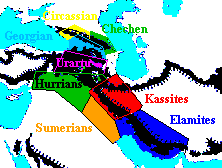
Assyrian annals. Even the name Urart.u is Assyrian. In Urartuan it was Biainili. This a good clue that Urartuan was an unrelated language. It was. The language was one of the non-Semitic and non-Indo-European languages of the ancient Middle East, like
Sumerian, Elamite, Hurrian, and Kassite, and like three separate groups of surviving languages in the Caucasus (Georgian,
Circassian, etc.). The language is known from Urartuan inscriptions; but there are no other texts or literature surviving in the language, so our knowledge of Urartuan history is relatively impoverished. When the Assyrian records cease to be informative, and Urartuan inscriptions thin out, events disappear from history.
Urart.u was regarded by the Assyrians as a major enemy. They were ultimately able to defeat and roll back the
Urartuans, but never overrun or conquer them. More damaging for the survival of the Kingdom were nomadic inroads by the Scythians and Cimmerians. After Rusa II things get very obscure, and the only certain thing (more or less) is that the
Medes end up in possession of the area, variously stated as by 590 or 585 -- part of the campaign that led to
Lydia and the Battle of the Eclipse. What is curious is what emerges next: the
Armenians. The Urartuan language disappears, like the closely related Hurrian. The classic Kingdom was already a mixture of various groups, as can easily happen in a mountainous region with isolated valleys, including speakers of an Indo-European language, Armenian, apparently closely related to Phrygian and Cappadocian further west. The Urartuan speakers ended up linguistically and/or demographically overwhelmed. Urart.u thus tends to be regarded as the institutional predecessor of the later Armenian kingdoms. The word
"Urart.u" itself is evidently preserved in the name of Mt. Ararat (16,940 ft.), an active volcano
and called Agri. It has gained the reputation of being the site of the resting place of Noah's Ark.
The list of Kings is from Amélie Kuhrt,
The Ancient Near East, c.3000-330 BC
[Routledge, 1995, 2000, Volume II, p.552] and A.E. Redgate, The Armenians [Basil Blackwell, 1998, 2000, pp.29-30].
A noteworthy detail in Redgate is that a title of the Urartuan King was "Kings of Kings" [p.43]. This is familiar from the Assyrians, Medes, and Persians, but Redgate says that before
Tukulti-Ninurta I (1244-1208) used it, it was previously just used for gods (apart from the name of the Sargonid
Shar-kalli-sharri, "King of all Kings"). Redgate thinks this implies a claim to divine kingship, passed on to the
Persians, not so much from Assyria as from Urart.u (Kelley L. Ross,
Ph.D.)
About TransAnatolie
TransAnatolie
Tour (Multi-Lingual Cultural Tour Operator)
TransAnatolie Tour is a subgroup of Anadolu
and is a Multi-Lingual Cultural Tour Operator in Anatolia (Asia
Minor) Turkey.TransAnatolie Tour
has the ambition and the capacity to be become one of the leading provider and
operator of archaeological, historical, belief (biblical) and cultural
heritage tours and specialty travel with high Quality of Service (QoS)
concept.
TransAnatolie Tour develops its programs with a network of
Specialists, who are well recognized, local, regional, national, and international
professionals at the top of their fields. These Specialists share their
knowledge, insights and vision providing an in-depth insiders understanding of
what distinguishes a particular culture and what factors shaped its evolution.
TransAnatolie Tours are executed in five
languages (Dutch, English, French, German and Turkish) with high QoS concept
by Tourism Professionals of valuable experience, intelligence and high
intellectual capacity.
TransAnatolie Tour executive and operations
teams have been at the cutting edge of international tour (holiday) operations
and specialty travel since 1990s, working with organizations, universities and
museums to provide unique travel experiences, cultural and belief (biblical) tours
(holidays/trips) to their memberships.
Multi-Lingual TransAnatolie Tour team members
have many years of valuable experience in providing individuals and
organizations with high quality cultural, historical, belief/biblical,
archaeological, architectural tours and travel experiences with high quality of
service (QoS).
TransAnatolie has immersed travelers in
Anatolia's most fascinating ancient cultures and provided enriching travel
experiences.
TransAnatolie (International Multi-Lingual
Cultural Tour Operator) has also been in small boat cruises, building exciting
travel packages around these unique vessels.
TransAnatolie is now
expanding its distribution by making these high quality, unique travel
products and programs available to the public. Supported by our international
network of offices and affiliates worldwide, the aim of TransAnatolie Team of
travel professionals and passionate program specialists is to make your next
'vacation' a truly rewarding travel experience.
TransAnatolie Tour is a member of
-
Turkish Ministry of Culture and Tourism (Licence
No. 4938)
-
Ankara Chamber of Commerce (Trade registry under
No. 54/1024)
-
Turkish-French Cultural Association
-
Turkish Association at the United Nations
-
Union of Turkish Tour Operators (TÜRSAB)
-
Union of Multi-Lingual Professional Tourism Guides (TUREB-ARED)
-
Ankara Cultural Tourism Association (BATUDER)
-
Nigde Cultural Association
-
Aksaray Cultural Association
-
Arts & Cultural Association of Taspinar.
TransAnatolie info-webs
(pages)
On these webs you will find background
information about our company, our offices, our current job offers and more info
about current and future products and services.
If you could not find the information you need on these pages and/or
on our other
pages, or for inquires please do not hesitate to contact us at:
info[at]transanatolie.com

-
TransAnatolie Tour
-
Multilingual Cultural Tour Provider and Operator
- A - Group
License N°4938 - The Turkish Ministry of Culture and Tourism
|